The conversation around AI Advisory for real estate has shifted from exploration to execution. Firms that began building AI capabilities in 2024–2025 are now translating those investments into measurable operational advantage, while others remain stalled at the starting line.
This gap is no longer theoretical. It is structural.
Across client conversations, a consistent signal is emerging: organizations recognize the importance of AI but lack a clear path to implementation. The issue is not awareness, it is execution.
An Automation Center of Excellence (CoE) is increasingly becoming the mechanism that bridges that gap.
What’s Driving Urgency in AI Adoption Right Now?
The pace of innovation in PropTech and AI has accelerated meaningfully over the past 12–18 months.
Key developments include:
- Lease abstraction at scale using LLMs and structured extraction pipelines
- Automated close processes integrating directly with financial systems like Yardi and MRI
- Agentic workflows capable of executing multi-step business processes autonomously
These are no longer experimental capabilities. They are being deployed in production environments.
Market Signal: The AI Capability Gap Is Widening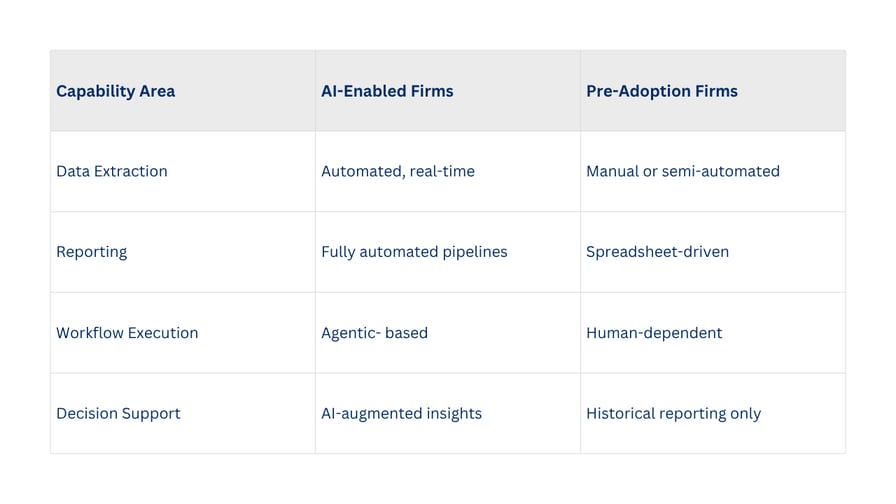
The implication is straightforward: firms that delay implementation are not standing still, they are falling behind.
Why Most Real Estate Firms Struggle to Implement AI
Despite strong interest, adoption friction remains high. The most common constraint is not technology, it is structure.
Typical challenges include:
- No centralized ownership of AI initiatives
- Fragmented automation efforts across departments
- Limited internal technical expertise
- Lack of prioritization frameworks
- Difficulty translating use cases into deployable solutions
This is where most AI initiatives stall: between ideation and execution.
What Is an Automation Center of Excellence (CoE)?
An Automation Center of Excellence is a structured, repeatable framework for scaling AI and automation across an organization.
Rather than approaching AI as a series of isolated projects, the CoE model introduces:
- Embedded expertise aligned to business functions
- Continuous opportunity identification across departments
- Standardized delivery pipelines from discovery to deployment
- Ongoing optimization and maintenance
This transforms AI from a one-time initiative into an operational capability.
How the CoE Model Works in Practice
1. Collaborative Teaming
AI adoption is most effective when it is embedded within existing workflows.
The CoE model integrates with:
- Accounting
- FP&A
- Property Management
- Operations
Internal stakeholders act as process champions, identifying opportunities and validating outcomes.
2. Managed Resourcing
Execution requires a blend of capabilities that most firms do not maintain in-house.
A typical CoE structure includes:
- Project Management
- Business Analysis
- Automation Development
Delivered as a managed service, this model ensures consistent velocity without overextending internal teams.
3. Structured Delivery Pipeline
The CoE introduces discipline into how automation is deployed:
- Continuous intake of automation opportunities
- Regular prioritization based on impact and feasibility
- Solution scoping and technical design
- Development and system integration
- Deployment and performance monitoring
This replaces ad hoc experimentation with a repeatable execution engine.
Where AI Is Already Delivering Value
Several high-impact use cases are already being implemented across real estate portfolios:
- Bank Reconciliation Automation
Matching transactions between bank data and ERP systems - Report Automation
Generating recurring financial and operational reports - Data Systemization
Extracting structured data from leases and documents - Bank-to-Book Automation
Recording transactions directly into systems of record - Document Workflow Automation
Triggering downstream processes from executed agreements
These are not future-state scenarios, they are active deployments.
Why the CoE Model Creates an Early Mover Advantage
The advantage of early AI adoption is not just efficiency, it is compounding capability.
Organizations that implement a CoE gain:
- Faster iteration cycles
- Accumulated institutional knowledge
- Reusable automation frameworks
- Lower marginal cost of future deployments
In contrast, late adopters face increasing complexity as the technology baseline rises.
Risks and Misapplications to Consider
While the CoE model is effective, it is not without constraints:
- Over-automation risk: Not all processes benefit from automation
- Change management friction: Adoption requires stakeholder alignment
- Data quality dependencies: Poor inputs limit AI effectiveness
- Vendor overreliance: Lack of internal ownership can create long-term risk
A well-structured AI Advisory approach mitigates these through governance and prioritization.
Conclusion: The Window to Build AI Advantage Is Open, But Narrowing
The shift from AI exploration to execution is already underway across real estate.
What’s changing now is not just the technology—it’s the pace at which firms are operationalizing it. Capabilities like automated reporting, lease abstraction, and agentic workflows are moving into production, creating measurable efficiency gains and, more importantly, compounding strategic advantage.
At the same time, a consistent theme continues to surface in conversations: “We know we need to adopt AI—we just don’t know how or where to start.”
That’s exactly the gap the Automation Center of Excellence is designed to solve.
Rather than approaching AI as a series of disconnected initiatives, the CoE provides a structured, repeatable path to adoption—embedding expertise, prioritizing the right use cases, and driving continuous execution across your organization.
The firms that move now are not just implementing tools—they are building long-term capability. And as that capability compounds, so does the distance between those leading and those still evaluating.
Ready to Start the Conversation?
If AI is on your roadmap, but execution is the challenge, lets talk.
We’re currently working with real estate organizations to launch and scale AI Advisory and Automation CoE programs, helping teams move from idea to impact quickly and with structure.
Book a conversation with our team to walk through:
- Where AI can drive the most immediate value in your organization
- What a CoE model would look like in your environment
- How to move from “we should do this” to a clear, executable roadmap
FAQs: AI Advisory and Automation CoE in Real Estate
What is AI Advisory in real estate?
AI Advisory involves guiding organizations through AI strategy, use case identification, implementation, and scaling—typically aligned to operational and financial outcomes.
How does an Automation Center of Excellence differ from project-based automation?
A CoE is continuous and scalable, whereas project-based automation is discrete and often lacks long-term integration or optimization.
How quickly can a CoE deliver results?
Initial use cases can often be deployed within weeks, particularly through “quick start” automation solutions, with broader impact compounding over time.
What systems can be integrated into a CoE model?
Common integrations include Yardi, MRI, AppFolio.
Is AI adoption only relevant for large firms?
No. Mid-sized firms often benefit the most, as they can scale capabilities quickly without legacy complexity.
What is the biggest barrier to AI adoption today?
Execution. Most firms understand the opportunity but lack the structure to implement consistently.
How do you prioritize AI use cases?
By evaluating impact (time savings, cost reduction) against feasibility (data availability, system complexity).