AI-Powered FP&A & Excel Reporting Platform
Collect, report, and analyze data with ease using the FP&A, Treasury Management, and Excel-based reporting solution built for finance professionals

The Operating system for the CFO
The operating system purpose-built for the CFO
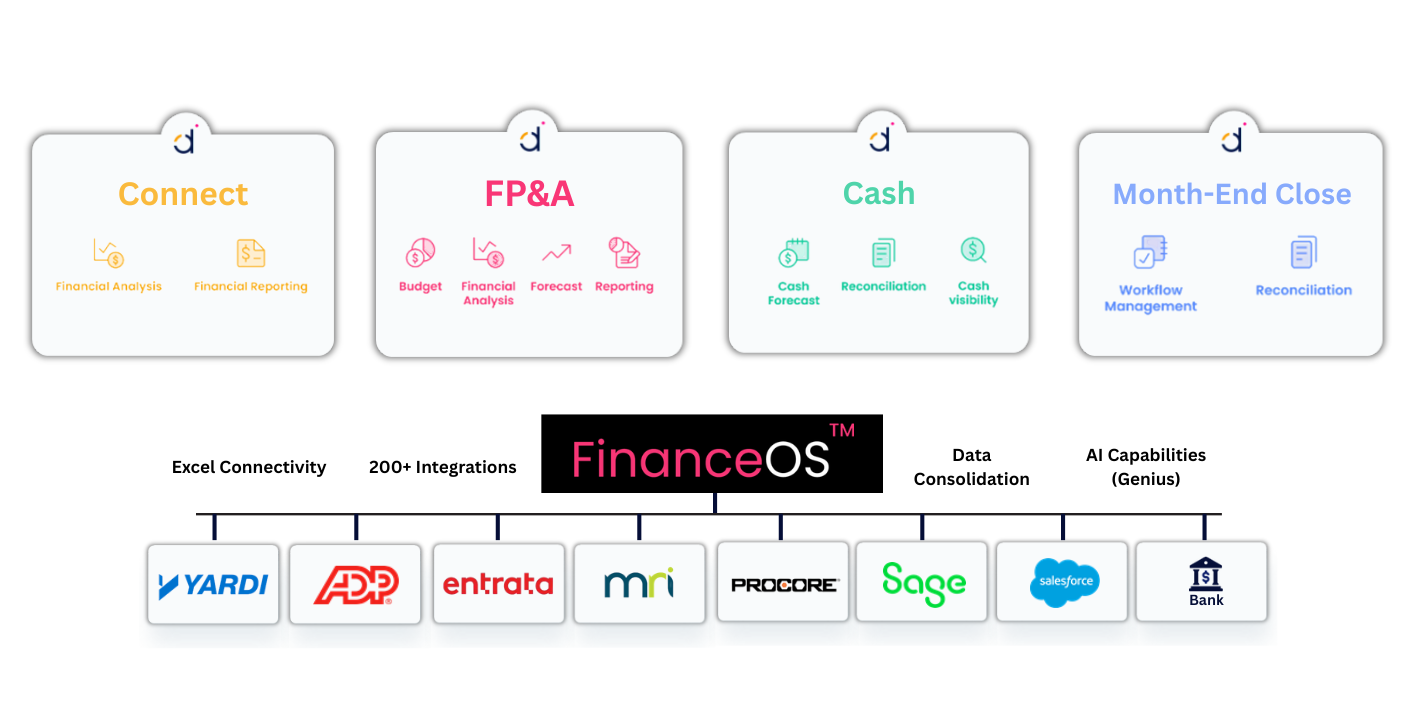
CONNECT by Datarails
Datarails Connect links your Excel spreadsheets to critical systems like Yardi, MRI, CRM, and HRIS—turning tedious manual work into efficient, automated processes.
Key Benefits:
- Live Updates: Access real-time actuals with a click—no more exporting or VLOOKUPs.
- Cloud-Based Efficiency: Store data in the cloud while keeping Excel fast and responsive.
- Data Consolidation: Seamlessly combine data from multiple systems and ledgers in Excel.
- Flexible Queries: Use formulas, mirrored tables, or full reports connected directly to your source systems.
Automate reporting, improve accuracy, and speed up decision-making—without changing the way you work.
Learn More About CONNECTDatarails FP&A
Datarails empowers finance teams by automating consolidation, reporting, and forecasting—directly within Excel. Through our partnership, REdirect proudly brings you this powerful solution designed to boost efficiency and insight, without changing the tools your team already knows.
Datarails for MRI Software & Yardi Systems: Smarter Financial Reporting for Real Estate Teams
Managing financial data across MRI, Yardi, Excel, ERPs, and CRMs is time-consuming, error-prone, and limits visibility. That’s where Datarails comes in.
By integrating directly with MRI Software & Yardi Systems, Datarails automates data consolidation, streamlines reporting, and enhances forecasting—so your team spends less time in spreadsheets and more time on strategy.
Common Challenges We Solve:
- Manual, disconnected data from MRI, Yardi, and other systems
- Slow, siloed reporting processes
- Limited financial visibility and collaboration
- Manual workflows that hinder scalability
Upgrade Your Financial Reporting and Planning
LEARN MOREDatarails Cash
Understand your cash position—past, present, and future.
The Datarails Cash module brings complete visibility to your organization's liquidity with automated reporting and forecasting tools.
Key Features:
- Balances Screen: View real-time and historical balances across accounts, currencies, and entities—with 7-day breakdowns and currency conversion.
- Transactions Screen: Analyse detailed cash transactions and categorize using smart rules for consistent insights.
- Cash Flow Forecasting: Build dynamic forecasts using real-time data from connected banks and financial inputs like AR, AP, and revenue.
Datarails Month-End
Take control of your month-end close process with features built to improve visibility, automate workflows, and reduce risk—designed with MRI and Yardi users in mind.
Task Coordination
Close Visibility
Reconciliation Management
Multi-Entry & Intercompany Support
Document Centralization
Excel Compatability
Exclusive REdirect Offer
Enjoy two free users as part of our special partnership offer, saving you hundreds each month.
Ready to Transform Your Finance Function?
Get in touch with our team to learn how Datarails + REdirect can support your FP&A goals.
Contact us todayFAQs
Q.
How does Datarails integrate with property management systems like Yardi and MRI Software?
A.
Datarails connects to Yardi and MRI Software through its CONNECT module, automatically pulling financial data from your property management systems without manual exports or VLOOKUPs. Yardi integration is accomplished through SFTP (Secure File Transfer Protocol) with scheduled data refreshes, while MRI Software connects directly through available integrations. The integration maintains regular updates between your Excel spreadsheets and source systems, allowing real estate finance teams to consolidate property-level data, lease accounting information, and portfolio metrics while continuing to work in familiar Excel environments.
Q.
Can Datarails handle complex real estate financial modeling like NOI forecasting and portfolio valuations?
A.
Yes, Datarails supports sophisticated real estate financial modeling including NOI forecasting, cash flow projections, portfolio valuations, and scenario planning by combining real-time property data with Excel’s advanced modeling capabilities. The platform enables finance teams to build dynamic models that automatically update with actual performance data from property management systems, while maintaining the flexibility to incorporate market assumptions, cap rates, and investment return calculations specific to real estate portfolios.
Q.
How long does it take for real estate finance teams to learn and adopt Datarails?
A.
Most real estate finance professionals become productive with Datarails within 2–4 weeks since the platform works directly within Excel, eliminating the need to learn entirely new software interfaces. The learning curve primarily involves understanding how to use Datarails formulas to pull data from connected systems and setting up automated workflows, with property accountants and FP&A analysts typically mastering core functions significantly faster than traditional FP&A platforms that require leaving Excel behind.
Q.
How does Datarails compare to Planful or Adaptive Planning for real estate companies?
A.
Datarails differentiates itself from Planful and Adaptive Planning by allowing real estate teams to continue working entirely within Excel while automating data consolidation, whereas competitors require users to adopt proprietary interfaces that often struggle with property-specific calculations like rent rolls and CAM reconciliations. While Planful and Adaptive offer robust planning features, Datarails typically provides faster implementation times and lower total cost of ownership for real estate organizations that have already invested heavily in Excel-based reporting templates and models.
Q.
What support does REdirect provide during Datarails implementation for real estate clients?
A.
REdirect Consulting helps real estate organizations implement Datarails by mapping existing Yardi and MRI data structures to Datarails’ consolidation framework, ensuring property hierarchies, lease accounting data, and portfolio reporting requirements are properly configured. Our consultants provide hands-on setup of automated workflows for month-end close, budget variance reporting, and cash flow forecasting while training finance teams on best practices specific to real estate financial management within the platform.
Q.
Can Datarails automate recurring real estate reports like rent rolls and occupancy analytics?
A.
Datarails automates recurring real estate reports including rent rolls, occupancy analytics, lease expiration schedules, and portfolio performance dashboards by pulling live data from property management systems and refreshing Excel-based reports on scheduled intervals. The platform’s automation capabilities extend to distributing these reports via email, maintaining version control, and creating board-ready presentations that update automatically with the latest property performance metrics and variance analyses.
Q.
What is the typical ROI timeline for implementing Datarails in a real estate organization?
A.
Real estate companies typically see positive ROI from Datarails within 6–9 months through time savings on monthly reporting cycles, often reduced by 40–60%, elimination of manual data entry errors, and faster delivery of critical metrics like property NOI and portfolio valuations. The investment varies depending on company size and modules selected, with most firms recovering costs through reduced overtime during month-end close and reallocation of staff from data manipulation to strategic analysis.