
As an Account Executive at REdirect working with hundreds of Yardi and MRI Software clients, I hear the same message almost every other call with clients:
“We need better reporting.”
But what does better actually mean?
Faster?
More flexible?
Investor-ready?
Automated?
Consolidated across systems?
Less Excel chaos?
The truth is — there is no one-size-fits-all reporting solution for real estate companies.
And that’s where the car analogy comes in.
Credit to Faraz Memon, Princpal at REdirect for bringing the car analogy into our reporting conversations. It’s a practical way to simplify a complex topic, and it’s become a helpful framework we regularly use with both our team and our clients.
Choosing a Reporting Tool Is Like Buying a Car
There are hundreds of car brands, models, trims, and colors. Why does someone choose one over another?
A convertible for the mid-life crisis.
A minivan for the growing family of five.
A Ford truck because you’re proudly American.
A hybrid because you want efficiency.
With all jokes aside — people buy the car that solves the problem they’re trying to solve.
Real estate reporting is no different.
There are many reporting solutions available to Yardi and MRI clients. The key question is:
What problem are you actually trying to solve?
At REdirect, we guide clients through a handful of primary reporting paths. Understanding these buckets helps finance and operations teams make informed decisions instead of jumping straight into a tool purchase.
The Three Reporting Paths for Real Estate Operators, Property Managers, REITS
1. Custom ERP (Yardi, AppFolio & MRI) Reporting
For some operators, the solution isn’t a new platform. It’s better use of what you already have.
If you:
- Have one to three standard reports that rarely change
- Run them weekly or monthly
- Export from Yardi or MRI into Excel
- Spend many hours manually formatting rather than analyzing
- Don’t require heavy investor customization
- Custom financial statements
- Modified rent rolls
- Automated report scheduling
- Query-based reporting optimization
- Uses one or two core systems (such as Yardi, MRI, or Excel)
- Has accounting teams that live in Excel
- Frequently changes reporting parameters
- Has outside investors requesting custom views
- Needs budgeting and forecasting flexibility
- Requires consolidated portfolio dashboards
Then enhanced ERP reporting may be enough.
This could include:
- Custom financial statements
- Modified rent rolls
- Automated report scheduling
- Query-based reporting optimization
This approach works well for stable portfolios with predictable reporting needs and limited system complexity.
Before adding another layer of technology, it’s worth asking:
Are we fully leveraging our ERP reporting capabilities?
When clients choose to optimize reporting directly within their ERP, REdirect supports the process end to end. We begin by scoping and documenting detailed reporting requirements — understanding the frequency, level of detail, and investor or operational needs behind each report.
From there, our consultants build the reports using native Yardi and MRI Software custom reporting tools, ensuring calculations, filters, and formatting align with accounting logic and real estate best practices and the Client’s requirements. Once validated, we deploy the reports directly into the client’s environment, configure scheduling if needed, and provide training so internal teams can confidently run and maintain them going forward.
2. Adding a BI Layer: Power BI & Datarails
As reporting needs grow, many clients move toward a Business Intelligence (BI) layer that connects to their ERP.
This is where flexibility increases.
If your company:
- Uses one or two core systems (such as Yardi, MRI, or Excel)
- Has accounting teams that live in Excel
- Frequently changes reporting parameters
- Has outside investors requesting custom views
- Needs budgeting and forecasting flexibility
- Requires consolidated portfolio dashboards
Then a BI tool is often the right step.
One solution we frequently see real estate clients leverage is Datarails.
How Real Estate Clients Are Leveraging Datarails
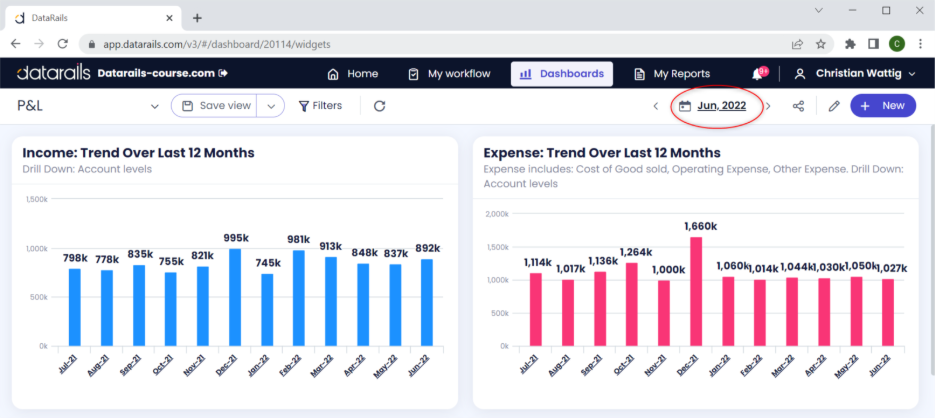
Datarails is an FP&A platform designed specifically for finance teams who want to stay in Excel while adding automation, consolidation, and real-time visibility.
Unlike traditional BI tools that can require heavy IT involvement, Datarails is built for accounting and finance professionals.
Here’s how real estate clients are using it:
Automated Data Consolidation
Financials are pulled from Yardi or MRI and synced into structured reporting models. Version control improves, and manual copy-and-paste processes are reduced.
Flexible Financial Reporting
Teams build property-level and portfolio-level dashboards, automate budget versus actual reporting, generate investor-ready packages, and track debt or covenant metrics.
Scenario Planning and Forecasting
“What-if” modeling becomes easier. Clients can reforecast based on occupancy changes, test expense assumptions, and evaluate capital planning decisions.
Executive Dashboards
Leadership gains access to portfolio KPIs, NOI trends, leasing performance, and expense variance reporting in one centralized environment.
For operators with one primary source of truth, this approach often provides the right balance between control and flexibility without building a full data warehouse.
Adding a BI Layer: Power BI
Another common path for real estate operators is implementing Microsoft Power BI as a Business Intelligence layer on top of Yardi, MRI, or other financial systems.
Power BI is a robust analytics platform that allows organizations to transform ERP data into interactive dashboards and dynamic reporting environments.
For real estate companies, this often means:
- Portfolio-wide financial dashboards
- Property performance tracking
- Budget vs. actual visualizations
- Occupancy and leasing analytics
- Capital project reporting
- Executive-level KPI dashboards
- Clients are a Microsoft tech stack company
- Leadership wants high-level dashboard visibility
- Operations teams need cross-property comparisons
- Finance teams require consolidated portfolio views
- Data needs to be visual and presentation-ready
- Uses multiple ERPs
- Has several Excel trackers across departments
- Works with third-party property managers, disparate data
- Manages multi-fund or institutional structures
Unlike static ERP reports, Power BI allows users to drill down into data, filter dynamically, and view trends across time periods, entities, or asset classes.
It is especially powerful when:
- Clients are a Microsoft tech stack company
- Leadership wants high-level dashboard visibility
- Operations teams need cross-property comparisons
- Finance teams require consolidated portfolio views
- Data needs to be visual and presentation-ready
For clients exploring a BI layer — whether that’s Microsoft Power BI or Datarails — REdirect supports you from evaluation through implementation. We regularly help real estate operators assess which BI tool best aligns with their team structure, reporting complexity, and long-term goals.
From there, we build out dashboards, structure ERP data connections properly, and support ongoing report development and user training. If you’re considering a BI solution, feel free to reach out to us to set up a demo and see firsthand how we’ve helped other clients select the right platform, build reports, and successfully support their BI environments.
3. Multiple Systems? Consider a Data Warehouse Strategy
When reporting complexity increases significantly, architecture matters.
If your organization:
- Uses multiple ERPs
- Has several Excel trackers across departments
- Works with third-party property managers, disparate data
- Manages multi-fund or institutional structures
Then layering BI directly on top of messy data can create long-term challenges.
This is where platforms like Cherre come into play.
The Data Warehouse Approach
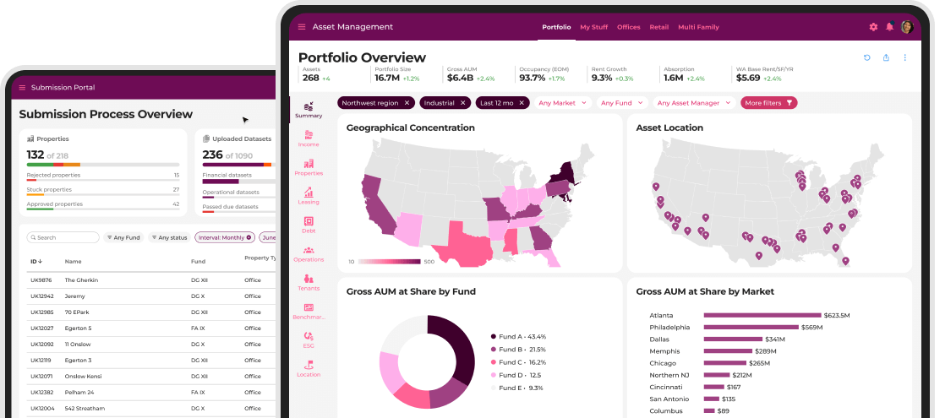
Cherre focuses on aggregating and standardizing data before analytics are applied.
This approach includes:
Aggregating Disparate Sources
Data from Yardi, MRI, Excel, CRM platforms, third-party managers, and external market feeds are centralized.
Standardizing and Structuring Data
Property IDs are normalized. Entity mapping is aligned. Data governance improves. Inconsistencies are reduced.
Creating a Central Data Foundation
Once clean and structured, BI tools including Cherre’s native solution can sit on top of a stable architecture.
This model is typically suited for:
- Larger portfolios
- Institutional operators
- Multi-fund managers
- Complex reporting environments
- Assess current reporting architecture
- Identify gaps and inefficiencies
- Determine whether ERP optimization is sufficient
- Evaluate BI tools like Datarails, Power BI, Cherre, etc.
- Explore data warehouse solutions when complexity demands it
- Build phased reporting roadmaps
- Duplicate ERP capabilities
- Require more IT lift than expected
- Don’t align with investor reporting requirements
- Solve one problem but create another
- The right solution for your complexity
- The right architecture for your growth stage
- The right balance between flexibility and control
It is more strategic and long-term in nature. It’s not just a reporting tool decision — it’s a data infrastructure decision.
Where REdirect Comes In
Most real estate firms don’t simply need a reporting tool. They need a reporting strategy.
At REdirect, we work with Yardi and MRI clients to:
- Assess current reporting architecture
- Identify gaps and inefficiencies
- Determine whether ERP optimization is sufficient
- Evaluate BI tools like Datarails, Power BI, Cherre, etc.
- Explore data warehouse solutions when complexity demands it
- Build phased reporting roadmaps
Our value lies in helping you understand what’s available before you invest.
Because in reporting, you don’t know what you don’t know.
We’ve seen firms purchase tools that:
- Duplicate ERP capabilities
- Require more IT lift than expected
- Don’t align with investor reporting requirements
- Solve one problem but create another
Taking a step back to define your reporting goals, growth trajectory, and internal capabilities often leads to better long-term decisions.
The Right Solution for Your Stage of Growth
There is no single “best” reporting solution for real estate companies.
There is only:
- The right solution for your complexity
- The right architecture for your growth stage
- The right balance between flexibility and control
If you’re asking, “We need better reporting,” the next step isn’t buying a tool.
It’s defining what better truly means for your organization.
REdirect is here to help you evaluate that journey — before you choose the car. Contact us today.
.png)
About the Author
Noelle Lipschutz
Noelle holds a degree in …