by Mark Sigal
Every executive board in commercial real estate (CRE) is currently asking the same question:
“What is our AI strategy?”
From automated portfolio analysis and exception tracking to conversational lease abstraction, the promise of artificial intelligence is undeniable.
C-suite leaders envision a future where they can simply ask a computer, “Which tenants have expiring leases in the next 18 months and declining sales trends?” and receive an instantaneous, bulletproof answer.
However, behind closed doors, early CRE AI initiatives are hitting a brick wall.
Companies are pouring hundreds of thousands of dollars into experimental AI projects, connecting powerful large language models (LLMs) to custom data lakes grounded in MRI or Yardi data.
The result? Hallucinated financial numbers, flat-out incorrect lease interpretations, and an entirely new set of security vulnerabilities.
The harsh reality facing CRE leadership today is simple:
The limitation of AI in commercial real estate isn’t the LLM. It’s your data model.
AI models are brilliant at processing text, but they lack intrinsic domain intelligence.
They do not naturally understand the complex web of relationships that defines commercial real estate: how suites connect to buildings, how base rent escalates alongside recoveries, how custom general ledger accounts map across different entities, or how people and departmental roles fit into these processes.
To achieve true AI readiness, CRE firms need more than a generic connection to their databases. They need a deep, domain-centric, purpose-built architecture that is both flexible and holistic.
That’s where Datex Property Solutions provides an immediate path to building an accurate, secure, and scalable CRE AI solution.
With deeply structured data covering buildings, tenants, vendors, leases, loans, sales, and the teams that manage them—paired with unstructured data such as contacts, comments, notes, and workflows—Datex provides the backbone needed to go live with AI in days.
Here’s how.
1. Twenty-Five Years of CRE Domain Expertise: Schema, Taxonomy, and Context
AI does not inherently know what a tenant, suite, or triple-net (NNN) recurring charge is.
For an LLM to deliver accurate and repeatable answers, it requires three foundational elements:
- Schema: How data fields are structured and linked.
- Taxonomy: How entities are named and categorized.
- Context: How complex, real-world CRE relationships and business rules interact.
Because Datex has spent a quarter-century refining its CRE-specific data model, our platform automatically provides the rich context AI requires.
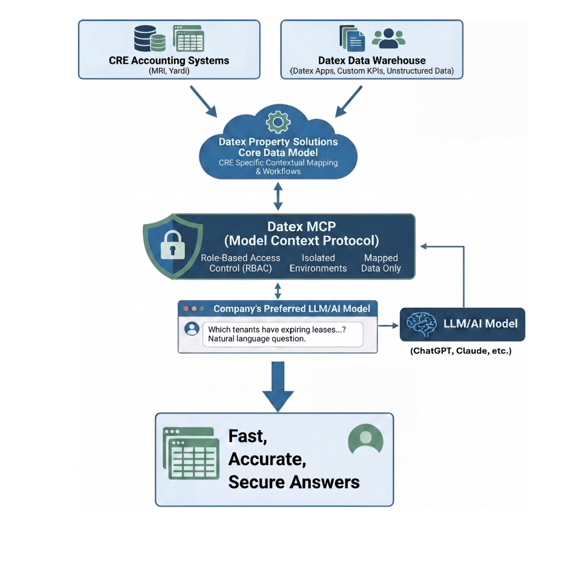
Datex enables you to use your preferred AI model, including ChatGPT or Claude, within a flexible, battle-tested data model. Your AI no longer has to guess how database tables relate to reporting structures, workflows, or teams.
2. Preventing High-Stakes Financial Hallucinations
In creative writing, an AI hallucination is an inconvenience. In CRE portfolio management, it can be a multimillion-dollar disaster.
Standard LLMs operate on statistical probability by predicting the next most logical word. When asked to calculate complex metrics such as CAM reconciliations, percentage-rent thresholds, or debt-service coverage ratios (DSCR), an unguided LLM may generate an answer that sounds confident and convincing but is completely false.
Datex acts as a strict guardrail and bridging layer between your AI model and your data.
Through a secure, role-based Model Context Protocol (MCP) server, the AI is restricted to retrieving vetted, standardized metrics, reports, and datasets.
When information is incomplete or unavailable, the Datex framework ensures the AI does not fabricate a convincing answer. It simply explains that it cannot answer the question because the required data is missing.
Through Datex’s Report Writer engine, this approach is readily extensible to your organization’s custom key performance indicators (KPIs) and reports. New KPIs can be created and instrumented in minutes, then deployed instantly in custom reports.
3. Extending ERP Data With Unstructured Insights and External Sources
Some of the most valuable context in commercial real estate exists outside structured database tables.
Datex extends your core ERP data by integrating disparate data sources and incorporating unstructured information, including:
- Qualitative notes and comments: Asset manager updates, lease-negotiation histories, budget-variance comments, work-order notes, and site-visit logs.
- Third-party data: Foot-traffic metrics, local market demographics, HVAC service details, and macroeconomic indicators.
- Operational logs: Maintenance tickets, tenant communication histories, and pipeline deals.
By blending structured accounting records with qualitative context, Datex allows your team to ask far more relevant questions, such as:
- “Which properties are underperforming against budget, and what reasons did asset managers provide in their latest monthly reviews?”
- “Show me all retail tenants that have experienced a sales decline of at least 15% over the past 90 days and are also showing deteriorating rent-payment trends.”
- “Summarize all deals in our leasing pipeline that have not changed status in 30 days, and tell me what the leasing notes suggest.”
This multidimensional context transforms AI from a basic search tool into a true executional copilot.
4. Eliminating the Expense and Risk of In-House Data Lakes
When CRE companies realize their core databases are not AI-ready, they often turn to what seems like an inevitable requirement: a custom data lake.
This is rarely as straightforward as it initially appears. The initial and recurring costs of development and operation can become jaw-droppingly expensive.
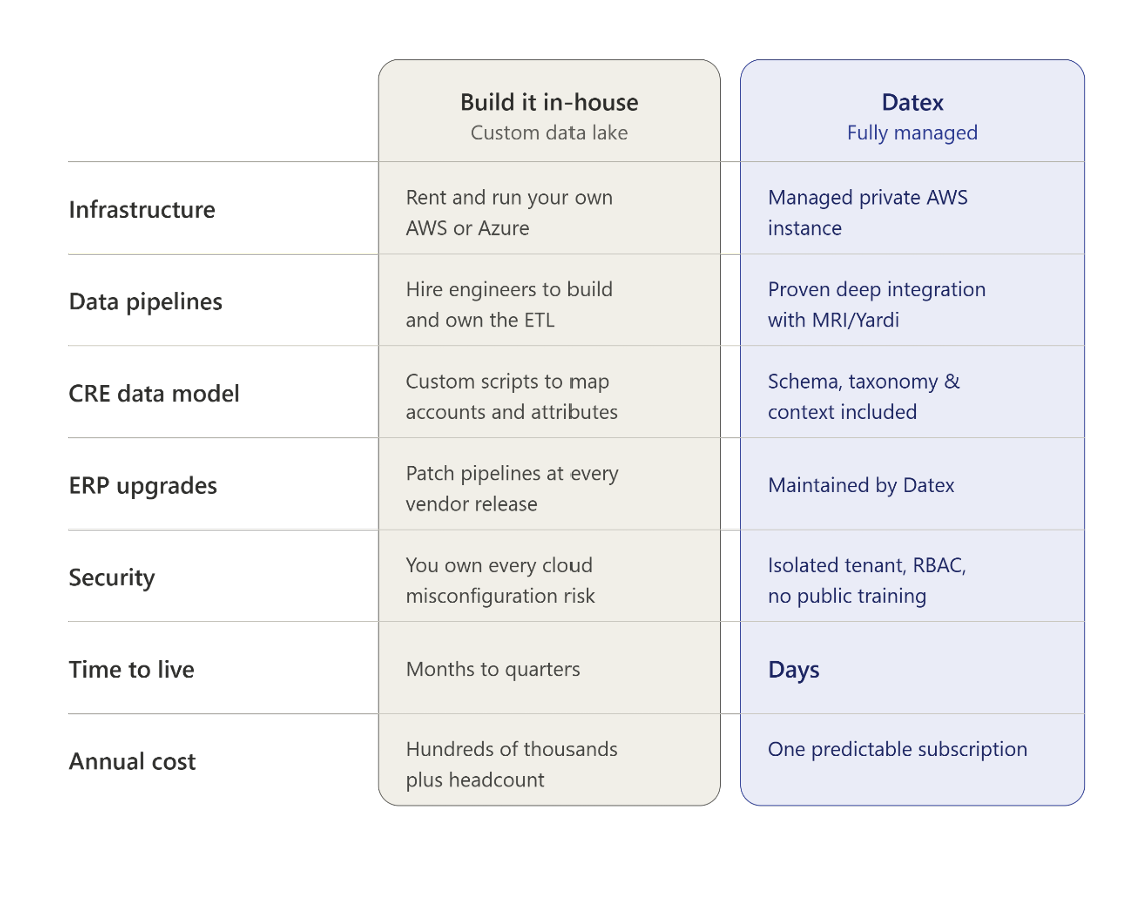
Building and maintaining a proprietary data lake can cost hundreds of thousands of dollars annually, consume significant human resources, and expose the enterprise to serious cybersecurity vulnerabilities.
Creating an in-house enterprise data lake typically involves:
- Renting and managing cloud infrastructure through providers such as AWS or Azure.
- Hiring specialized data engineers to build extract, transform, and load (ETL) pipelines.
- Writing custom scripts to map Yardi or MRI tables, account groups, account trees, attributes, and financial formats.
- Continually maintaining and patching pipelines whenever ERP vendors update their software.
- Maintaining constant vigilance over data integrity and security.
- Supporting an endless stream of feature requests and system enhancements.
- Onboarding, training, and supporting new and existing users.
With Datex, you can bypass the data lake trap entirely.
We provide a secure, private, fully managed cloud environment where your data is ingested, cleaned, updated, and actively governed—giving you enterprise-grade AI infrastructure without the technical debt, backed by top-tier support.
5. Enterprise-Grade Security and Role-Based Access Control
AI adoption in the corporate world often stalls because of security concerns—and rightfully so.
You cannot simply connect an LLM to an entire corporate database and give every employee unrestricted access.
Without granular controls, a property manager could ask the AI to reveal executive salaries, portfolio-wide debt obligations, or confidential partner distributions. Feeding proprietary real estate data directly into public AI models may also risk exposing valuable competitive intelligence to third parties.
Datex addresses security at every level:
- Isolated environments: Your data is hosted in dedicated, highly secure server instances.
- Model isolation: Queries are routed through secure MCP connections to your company’s preferred model provider, such as ChatGPT or Claude, helping ensure that your proprietary data is not used to train public LLMs.
- Role-based access control (RBAC): Datex enforces strict permissions based on each user’s role. If an asset manager is authorized to view only Mid-Atlantic regional properties, the AI will answer questions using data from only those specific assets.
Take the 30-Day AI Live Test Drive and Data Readiness Scan
You do not need to commit to a multiyear engineering project or buy into vague vendor promises to determine whether AI will work for your portfolio.
With Datex AI Live, you can see exactly how AI performs using your actual data—across your entire portfolio—in a matter of days.
Here’s how it works.
Zero Impact on Production
You provide Datex with a secure backup copy of your MRI or Yardi database. Your live operational system is never touched.
Comprehensive Audit
We run a deep diagnostic across your properties, leases, suites, budgets, and financials to generate an AI Readiness Action Plan.
You will see precisely where your data is clean, where broken relationships exist, and what needs to be fixed.
30 Days of Hands-On Testing
We deploy a private, secure sandbox environment and connect our MCP interface to the LLM of your choice.
For 30 days, your executive and operations teams can ask natural-language questions and experience the power of trustworthy CRE AI firsthand.
Stop Guessing. Start Realizing the Benefits of AI.
AI will undoubtedly redefine commercial real estate operations—but only for companies that establish the right data foundation first.
Through our partnership with Datex Property Solutions, we help CRE organizations evaluate their data readiness and implement secure, reliable AI solutions built around their operational needs.
Ready to see what trustworthy AI can do with your portfolio data?